


FAFO is a popular slang term you might see in text messages, TikTok comments, and online conversations. But what does FAFO mean, and why do people use it so often? FAFO stands for “F*** Around and Find Out.” It describes what happens when someone takes risks, makes reckless choices, or ignores a clear warning. In simple words, it means you may face the consequences of your actions.
This internet slang expression can sound funny, bold, or threatening depending on the situation. Whether you see it in a meme, a chat, or a social media post, understanding its texting slang meaning helps you read the message correctly.
What Does FAFO Mean in Text and Slang?

FAFO stands for “F* Around and Find Out.”** It’s a popular acronym and internet slang expression that tells someone their actions may lead to unwanted results. In simple terms, it means you might face trouble if you keep pushing limits or ignoring warnings. People use this abbreviation in text messages, social media comments, memes, and everyday conversations. The FAFO acronym meaning is closely connected to personal choices and their results. For example, if someone keeps teasing a friend after being asked to stop, another person might reply, “FAFO.” They’re suggesting that the teasing could eventually lead to an unpleasant consequence.
The FAFO phrase meaning can be serious, funny, or sarcastic depending on the situation. Its original wording contains a swear word, so dictionaries classify it as profanity or vulgar slang. However, many people prefer the shortened version because it feels less direct than spelling out the entire expression. You may also see people replace the original wording with “Fool Around and Find Out” when they want a cleaner version. Both versions communicate a similar message: careless choices can bring unexpected results. Still, FAFO isn’t always a friendly phrase. A person’s relationship with you and the surrounding conversation can change its meaning completely.
What Does FAFO Stand For?
The FAFO full form is “F*** Around and Find Out.” The first two letters represent the opening words, while the final two represent the result. Together, they create a short expression about taking risks and discovering what happens next. People usually say FAFO when someone ignores a warning or behaves recklessly. Imagine a person repeatedly touching a hot pan after someone tells them to stop. A friend might jokingly say, “FAFO, and you’ll learn quickly.” The message is simple: sometimes experience teaches a lesson that advice cannot.
FAFO Meaning in Text Messages
The FAFO meaning in text usually depends on the conversation and the relationship between the people involved. Friends might use it to tease someone who makes a silly choice. Someone else might send it as a serious warning during an argument. The FAFO meaning in messages can also express confidence when a person refuses to tolerate disrespect. For example, someone might text, “He kept bothering me after I told him to stop. FAFO.” This means the person believes the troublemaker will eventually face the results of their behavior. In short, FAFO is a quick way to communicate that actions have consequences.
What Does Fool Around and Find Out Mean?
“Fool Around and Find Out” is a cleaner way to express the original phrase. It describes what happens when someone experiments, takes unnecessary risks, or ignores reasonable advice. The expression doesn’t always involve serious trouble. Sometimes the result is simply embarrassment or a funny mistake. For instance, imagine your friend tries to flip a pancake without enough practice. The pancake lands on the kitchen floor. Someone might laugh and say, “Well, that’s what happens when you fool around and find out!” The phrase connects risky behavior, reckless actions, and bad decisions with the results they create.
FAFO Meaning in Simple Words
In everyday American English, FAFO means you should think about what might happen before doing something foolish. It reminds people that choices have results, whether those results are good or bad. The expression also suggests that someone may discover the truth through experience instead of listening to advice. Here are ten simple ways to understand its message.
1. Actions have consequences: Your choices can bring results you didn’t expect.
2. Don’t push your luck: Stop testing someone’s patience before things get worse.
3. Learn the hard way: You may understand a lesson after experiencing it yourself.
4. Think before acting: Consider what might happen before taking a risky step.
5. Don’t cross the line: Respect people’s limits and personal boundaries.
6. You were warned: Someone already explained what could happen.
7. Play stupid games, win stupid prizes: Foolish behavior often brings unpleasant results.
8. Don’t test people’s patience: Repeated disrespect can damage relationships.
9. Face the consequences: Take responsibility when your choices cause problems.
10. Experience teaches lessons: Sometimes mistakes reveal what advice couldn’t explain.
Where Did FAFO Come From? Origin and Popularity

FAFO didn’t suddenly appear with TikTok or modern texting culture. The full expression existed in informal speech before the four-letter abbreviation became widely recognized online. Its exact origin remains uncertain, so it’s difficult to credit one person or community with inventing it. Reporting by The Washington Post traces the expression to at least 2007 and discusses its connection with African American slang. An early Urban Dictionary entry from that year also associates it with biker terminology. However, an online dictionary entry doesn’t prove where the phrase first originated. The safest explanation is that FAFO developed through informal speech before spreading into mainstream internet culture.
The expression gained wider attention during the early 2020s. In 2022, a viral TikTok chart by creator Roger Skaer helped people visualize the connection between actions and consequences. The chart became a popular reaction image across different online communities. Later, public figures and political discussions brought FAFO to an even wider audience. On January 26, 2025, Donald Trump shared an AI-generated image featuring FAFO on Truth Social. The post helped push searches for the expression into the spotlight. Today, people use it in jokes, debates, reaction videos, and everyday conversations. Its message remains familiar even as its audience continues to grow.
The Origin and History of FAFO
The origin of FAFO is not completely settled. The underlying expression has circulated in informal American speech for years. Some historical discussions connect it with biker culture, while other research traces its use to African American slang. The Washington Post reported that lexicographer Jesse Sheidlower had traced the phrase back to 2007. However, this doesn’t establish the exact moment someone first said it. Slang often develops through everyday speech before anyone records it in a dictionary. FAFO is a good example of how an ordinary spoken expression can eventually become a recognizable part of online language.
How FAFO Became Popular on the Internet
The internet gave FAFO a much bigger audience. People began using the acronym in posts, comments, and memes because it communicates a strong message with only four letters. A major moment came in 2022 when TikTok creator Roger Skaer shared a humorous chart showing how increased risky behavior could lead to stronger consequences. The chart made the phrase easier to understand and share. Soon, people used it to react to videos of failed stunts, public arguments, and questionable decisions. Its popularity grew because the expression worked as both a joke and a warning. It also fit perfectly into the fast-moving world of short online comments.
Why FAFO Became Popular in American Culture
American internet culture often favors short expressions that communicate strong feelings. FAFO fits that pattern because it combines humor, confidence, frustration, and a warning in four letters. People use it when someone ignores advice or refuses to respect boundaries. It also appears in political conversations where users criticize decisions or predict their consequences. Public figures helped introduce the phrase to audiences who might not normally follow internet slang. However, its popularity doesn’t mean everyone uses it in the same way. For some people, FAFO represents personal confidence. For others, it sounds confrontational or aggressive.
What Does FAFO Mean on Social Media?

The FAFO meaning on social media generally stays connected to actions and consequences. However, the way people use it can vary across different platforms. On TikTok, users often place it under videos showing risky stunts or unexpected results. Instagram users might add it to captions or reaction comments. On Snapchat, friends may use it in private messages to tease someone about a questionable decision. Meanwhile, X and Facebook users often apply it to public disagreements and trending discussions. These different uses don’t create separate dictionary definitions. Instead, the platform and situation help determine whether FAFO sounds funny, serious, or threatening.
One reason FAFO works so well online is its flexibility. It can describe a person who ignored a warning, a funny mistake, or a situation that quickly went wrong. You might see it alongside TikTok comments, Instagram reels, Snapchat chats, and X comments. It also appears in viral memes that show someone making a bold choice and immediately regretting it. Consider a video of someone attempting a dangerous skateboard trick without practice. Viewers might comment, “That’s a FAFO moment.” They’re pointing out the connection between the person’s decision and its result. The phrase is short, but the situation gives it meaning.
FAFO Meaning on TikTok
The FAFO meaning on TikTok usually describes someone experiencing the results of their own behavior. Users often write it under videos showing failed challenges, risky stunts, or people ignoring clear warnings. It can also appear in political clips and reaction videos where creators criticize someone’s decisions. TikTok’s short-video format makes the expression easy to understand because viewers can see the action and its result almost immediately. For example, imagine someone tries to scare a dog despite several warnings from its owner. If the dog chases the person away, viewers might comment, “FAFO!” The comment suggests that the person discovered the consequences of ignoring a warning.
FAFO Meaning on Instagram and Reels
The FAFO meaning on Instagram is similar to its use on other platforms. People add it to captions, Stories, and comments when someone faces the results of a poor decision. It may appear under funny videos, relationship posts, or public arguments. On Instagram, the phrase can also work as a short caption that gives a video a bold or sarcastic tone. Imagine a Reel showing someone repeatedly ignoring a friend’s advice before making an embarrassing mistake. A viewer might comment, “You had one job. FAFO!” The message combines humor with a reminder that the person could have avoided the situation.
FAFO Meaning on Snapchat
The FAFO meaning on Snapchat often appears in private conversations between friends. Someone might send it after another person ignores advice or takes a silly risk. Since Snapchat conversations are usually informal, the phrase can sound playful when both people understand the joke. However, it can also carry a serious tone during disagreements. Imagine your friend texts, “I’m going to challenge him again even though he warned me.” You might reply, “FAFO.” The laughing emoji suggests that you’re teasing rather than threatening them. Without that friendly context, the same letters could sound much harsher.
FAFO Meaning on X (Twitter), Facebook, and Reddit
The FAFO meaning on Twitter, now known as X, often appears in public debates and reaction posts. Users may write it when someone faces criticism after making a controversial statement or decision. On Facebook, the phrase can appear in shared videos, political discussions, and community posts. Reddit users also apply it when discussing stories about people ignoring advice or creating problems for themselves. For example, someone might share a story about a neighbor who repeatedly parks in another person’s driveway. If the neighbor eventually gets towed, a commenter might simply write, “FAFO.” The comment suggests that the neighbor experienced the result of repeatedly ignoring boundaries.
FAFO in Internet Memes and Viral Trends
FAFO has become a natural fit for memes because its meaning is easy to show visually. Many memes follow a simple pattern: someone makes a risky choice, ignores a warning, and faces an unexpected result. The popular FAFO chart uses two ideas to explain this pattern. As the amount of reckless behavior increases, the expected consequences become stronger. People often share these images as humorous reactions to embarrassing videos or poor decisions. For example, a meme might show someone touching a wet-paint sign and then complaining about stained clothes. The caption “FAFO” delivers the joke without needing a long explanation.
You May Also Like: WTM Meaning in Text: What Does WTM Mean in Chat and Social Media?
How Is FAFO Used in Text Messages and Real Conversations?

The FAFO meaning in texting depends on the speaker’s intention and the situation. People use it to warn friends, react to mistakes, express frustration, or make sarcastic comments. In some conversations, it works as a playful warning between people who know each other well. In others, it becomes an aggressive message that suggests a person may face serious consequences. You might see FAFO in family group chats, online friendships, dating conversations, or gaming communities. The expression can even appear during heated disagreements. That’s why understanding the relationship between the speakers matters more than simply knowing the full form.
The phrase also connects with actions and reactions, personal responsibility, and cause and effect. Someone might use it after watching a friend ignore repeated advice. Another person could say it after witnessing someone behave disrespectfully. These situations show why FAFO isn’t limited to one type of conversation. It can describe funny mistakes, serious conflicts, or simple moments of learning. The following examples show how people might use FAFO in everyday situations. Each example includes a short explanation so you can understand the intended message.
FAFO as a Playful Warning Between Friends
Friends often use FAFO when someone keeps pushing their luck. In this situation, the phrase usually works as teasing rather than a serious warning. The speakers understand each other’s humor, so the expression doesn’t necessarily create tension. For example, one friend might warn another not to eat the last slice of pizza. If the other person ignores the warning, someone might jokingly say, “FAFO!” It can also appear when friends dare each other to try something silly. Here are ten examples of the FAFO meaning between friends.
1. “Keep stealing my fries. FAFO” — A playful warning about an annoying habit.
2. “You ignored my cooking advice. FAFO!” — A joke after someone ruins a meal.
3. “Try beating me again. FAFO!” — A friendly challenge during a game.
4. “I told you not to touch that paint.” — A reminder that someone ignored advice.
5. “You woke the sleeping cat. FAFO!” — A funny reaction to a predictable outcome.
6. “Don’t challenge me to another race. FAFO!” — A playful expression of confidence.
7. “You ate the spicy wings without milk. FAFO!” — A joke about facing the heat.
8. “She warned you about that haircut. FAFO” — A humorous reaction to a bad result.
9. “Keep changing the rules. You’ll find out!” — A friendly warning about unfair behavior.
10. “You thought that prank would work? FAFO!” — A joke after a prank backfires.
FAFO as a Reaction to Someone’s Bad Decision
People also use FAFO after someone makes a poor choice and experiences the result. The expression suggests that the outcome wasn’t entirely surprising. Perhaps someone ignored useful advice or refused to consider the risks. Instead of explaining the entire situation, another person might simply respond with FAFO. For example, imagine someone repeatedly drives too fast despite receiving warnings. After getting a speeding ticket, a friend might say, “Well, FAFO.” The message isn’t necessarily cruel. It simply points out that the person faced a consequence they could have avoided.
1. “He ignored every warning and lost his job. FAFO.” — His actions led to a serious result.
2. “She spent all her savings on a risky bet. FAFO.” — A poor financial choice brought trouble.
3. “He kept skipping practice and lost the final match.” — His lack of preparation affected the result.
4. “They ignored the weather warning and got caught in the storm.” — Their decision created unnecessary risk.
5. “He broke the rules and got disqualified. FAFO.” — He faced the result of his behavior.
6. “She kept lying until everyone stopped trusting her.” — Dishonesty damaged her relationships.
7. “He ignored the repair warning and damaged the engine.” — Avoiding maintenance became costly.
8. “They kept disturbing the neighbors and received a complaint.” — Their behavior created a problem.
9. “He tried to cheat and got caught on camera.” — His dishonest decision backfired.
10. “She refused to read the instructions and assembled everything backward.” — Skipping the directions caused trouble.
FAFO in Arguments and Conflicts
During arguments, FAFO can sound much more serious. Someone might use it to express frustration when another person keeps crossing boundaries. It can also communicate defiance when a speaker refuses to back down. In these situations, the expression may feel like a serious threat, especially when the conversation already includes anger or intimidation. For example, if someone repeatedly insults another person after being asked to stop, the response “Keep going. FAFO” can sound confrontational. It may suggest that the speaker expects the behavior to bring consequences. Always consider the surrounding words before deciding whether the message is harmless or threatening.
1. “I warned you to stop spreading rumors. FAFO.” — A serious response to repeated disrespect.
2. “Don’t mistake my patience for weakness.” — A firm statement about personal boundaries.
3. “You crossed the line after several warnings.” — The speaker is no longer accepting the behavior.
4. “Keep making false claims and face the consequences.” — A direct warning about harmful statements.
5. “I asked you to leave me alone. Please stop.” — A clear boundary without aggressive language.
FAFO in Dating and Relationships
The FAFO in dating and relationships context can be playful or uncomfortable. Couples and people dating might use it to joke about jealousy, flirting, or harmless challenges. However, it can also appear during serious disagreements about trust and respect. For example, someone might say, “You ignored every red flag. FAFO,” after a relationship ends badly. This use suggests that the person experienced the consequences of ignoring warning signs. Still, using FAFO during a sensitive breakup can sound harsh. A little humor works when both people understand it. Otherwise, a calmer expression may prevent unnecessary hurt.
1. “You ignored all those red flags. FAFO.” — A reaction to overlooking warning signs.
2. “You kept flirting with my partner after I asked you to stop.” — A statement about disrespectful behavior.
3. “You thought I’d never notice the lies? FAFO.” — A reaction to dishonesty.
4. “You challenged me to choose the movie. FAFO!” — A playful comment between partners.
5. “You kept canceling our plans, and now I’m making my own.” — A reminder that choices affect relationships.
FAFO in Gaming Chats
The FAFO in gaming chats meaning usually involves risky moves, competitive challenges, or failed strategies. Gamers might use the expression when someone attacks without a plan or underestimates an opponent. It can also appear after a player ignores warnings from teammates. For example, imagine a player rushes into an enemy base alone despite several teammates telling them to wait. If the player gets eliminated immediately, someone might type “FAFO.” In this setting, the phrase often works as a sarcastic reaction. However, it can also become a serious warning during heated multiplayer matches.
1. “You rushed the enemy base alone. FAFO!” — A reaction to a reckless move.
2. “Never challenge the final boss without healing.” — A warning about poor preparation.
3. “He ignored the team strategy and got eliminated.” — A consequence of refusing to cooperate.
4. “You underestimated that player. FAFO.” — A reaction to an unexpected defeat.
5. “Keep camping in that spot. Someone will find you.” — A warning about a predictable gaming result.
Real-Life FAFO Text Examples and Their Meanings
Real-life conversations make the FAFO examples in conversations easier to understand. The phrase can describe anything from a harmless kitchen mistake to a serious argument. These examples show how the same expression changes according to the situation. Notice how the surrounding details explain whether the speaker is joking or expressing frustration.
1. Friend: “I’m going to eat the whole bag of extra-hot chips.”
Reply: “FAFO”
Meaning: The friend is joking that the person may regret eating something too spicy.
2. Friend: “I ignored the parking signs and got a ticket.”
Reply: “Well, FAFO.”
Meaning: The speaker points out that ignoring the rules caused the problem.
3. Gamer: “I rushed the boss without healing.”
Reply: “That’s a FAFO moment.”
Meaning: The player made a risky decision and paid for it.
4. Friend: “I kept teasing my brother, and now he won’t talk to me.”
Reply: “You should’ve stopped when he asked.”
Meaning: The speaker explains that the teasing damaged the relationship.
5. Coworker: “He ignored the safety rules and got removed from the site.”
Reply: “FAFO.”
Meaning: The expression highlights the result of ignoring important rules.
6. Friend: “I tried to fix the sink without watching a tutorial.”
Reply: “How’s that going? FAFO!”
Meaning: The speaker jokes about the result of an unprepared attempt.
7. Friend: “She told him not to touch her phone, but he did it anyway.”
Reply: “FAFO. He crossed a boundary.”
Meaning: The person faced a consequence after ignoring someone’s request.
8. Gamer: “I challenged the strongest player and lost immediately.”
Reply: “Classic FAFO.”
Meaning: The speaker jokes about an overconfident challenge.
9. Friend: “I spent my rent money on shopping.”
Reply: “That could become a serious FAFO moment.”
Meaning: The speaker warns about the financial consequences.
10. Friend: “I ignored the weather forecast and went hiking.”
Reply: “Sounds like FAFO to me.”
Meaning: The speaker points out that ignoring the forecast created unnecessary trouble.
What Does FAFO Mean When Someone Says It to You?

When someone sends you FAFO, the first thing to consider is your relationship with that person. A close friend might use it to tease you about a silly decision. A stranger might use the same expression to criticize your behavior. Someone involved in an argument could use it as a warning that they won’t tolerate further disrespect. The FAFO meaning from a guy or FAFO meaning from a girl doesn’t have one fixed interpretation. Gender doesn’t determine the meaning. Instead, the speaker’s personality, your relationship, and the conversation provide useful clues.
You should also pay attention to what happened before the message. Did you make a harmless joke, ignore someone’s advice, or cross a personal boundary? Those details can reveal the speaker’s intention. A laughing emoji may suggest friendly teasing, while angry language can make the message feel more serious. However, emojis alone don’t prove that someone is joking. If the message makes you uncomfortable, you don’t need to dismiss your feelings. You can ask what the person means or set a clear boundary. Understanding tone and context is the best way to interpret FAFO accurately.
What Does FAFO Mean From a Guy?
The FAFO meaning from a guy depends on how he communicates with you. If he’s your close friend, he might use it after you make a funny mistake or accept a silly challenge. If you’re dating, he might say it playfully during a disagreement or use it to express frustration. However, the phrase can also sound aggressive when someone uses it to intimidate you. Consider these examples to understand different possibilities.
1. “You really tried that spicy challenge? FAFO” — Friendly teasing.
2. “I told you not to ignore that warning.” — A serious reminder.
3. “Keep testing my patience. FAFO.” — A potentially confrontational warning.
4. “You challenged me and lost. FAFO!” — A playful competitive reaction.
5. “You ignored the obvious red flags.” — A comment about poor judgment.
What Does FAFO Mean From a Girl?
The FAFO meaning from a girl also depends on the situation rather than her gender. She might use it jokingly when a friend ignores her advice. She could also use it to show confidence after someone disrespects her boundaries. In a serious disagreement, the expression may communicate frustration or a warning. Here are five possible examples.
1. “I told you not to touch my dessert. FAFO” — Playful teasing.
2. “You ignored every warning. What did you expect?” — A reaction to a poor decision.
3. “Don’t disrespect my boundaries again.” — A firm statement about personal limits.
4. “You thought I wouldn’t notice? FAFO.” — A reaction to dishonesty.
5. “You challenged me to a race and lost!” — A friendly competitive joke.
What Does FAFO Mean Between Friends?
The FAFO meaning between friends is often less serious because close friends understand each other’s humor. They may use it after someone ignores advice, accepts a challenge, or makes an embarrassing mistake. However, friendship doesn’t automatically make every use harmless. A message can still sound rude if it targets a sensitive issue. For example, joking about a friend’s failed cooking experiment may feel harmless. Using FAFO to mock their financial problems might feel hurtful. The relationship matters, but so does the subject of the conversation. When in doubt, consider whether the other person would laugh along.
What Does a FAFO Moment Mean?
The FAFO moment meaning describes a situation where someone experiences the results of their own choices. It usually happens after a person ignores advice, takes a risk, or crosses a boundary. The result may be funny, embarrassing, or serious. For example, imagine someone tries to impress their friends by jumping into a pool without checking its depth. If the jump goes badly, people might call it a FAFO moment. The phrase highlights the connection between a person’s decision and what happened afterward. In simple terms, it’s the moment when someone discovers the consequences firsthand.
Is FAFO Rude, Offensive, or a Threat?

FAFO can sound rude because its original full phrase contains strong profanity. Even when someone uses only the acronym, many readers understand the word hidden behind those letters. Dictionary.com classifies FAFO as vulgar slang and describes it as a warning or challenge about unwanted consequences. However, the expression isn’t automatically a threat. Friends may use it jokingly after a harmless mistake. In a heated disagreement, it may communicate anger or intimidation. The same four letters can carry different meanings depending on the speaker’s intention. That’s why you should never judge the phrase without considering the surrounding conversation.
It’s also important to separate offensive language from threatening behavior. A person can use a vulgar expression without intending physical harm. On the other hand, someone might use seemingly simple words to intimidate another person. Pay attention to specific statements, repeated messages, and the situation around them. If someone makes a direct threat or causes you to fear for your safety, take it seriously. Don’t assume it’s harmless just because FAFO appears in memes and jokes. The phrase can be humorous in one setting and deeply uncomfortable in another.
Is FAFO Considered a Bad Word?
FAFO is generally considered vulgar slang because the original expression contains the F-word. The acronym hides the profanity but doesn’t completely remove its meaning. Some people feel comfortable using it among friends, while others avoid it because they dislike swearing. You may also see censored versions such as “F*** Around and Find Out” or the cleaner “Fool Around and Find Out.” These alternatives help communicate a similar message without spelling out the original profanity. Still, FAFO may be inappropriate in formal situations, family discussions, or conversations with people you don’t know well.
Is FAFO Always Meant as a Threat?
No, FAFO doesn’t always represent a threat. Its meaning depends on whether the speaker is joking, criticizing someone’s behavior, or warning them about possible consequences. A friend might write “FAFO” after you try a spicy food challenge. That message probably expresses amusement rather than hostility. However, someone who writes “Keep coming near me. FAFO” during a heated argument may be communicating intimidation. The difference lies in the surrounding words and circumstances. Never assume every use is harmless, especially when someone has already shown aggressive behavior.
Can FAFO Be Used as a Joke?
Yes, people frequently use FAFO as a joking expression. It works especially well when someone makes a harmless mistake after ignoring friendly advice. Imagine your friend tries to carry six cups of coffee at once and spills them everywhere. You might laugh and say, “That’s FAFO!” The comment points out the predictable result without necessarily criticizing the person. People also use it in memes, gaming chats, and playful challenges. However, humor depends on the audience. A joke that feels funny between close friends might sound insulting to someone else.
How Context and Tone Change the Meaning of FAFO
The tone and context surrounding FAFO can completely change its message. A laughing emoji, friendly relationship, or harmless situation may suggest playful teasing. Angry wording, repeated warnings, or a tense argument can make it sound aggressive. Even punctuation can influence how a short message feels. Compare “FAFO” with “FAFO. I’m serious.” The first may sound like a joke, while the second feels much more confrontational. Still, written messages don’t always reveal a person’s true intention. If you’re unsure, asking for clarification is better than making assumptions.
You May Also Like: WTM Meaning in Text: What Does WTM Mean in Chat and Social Media?
How to Respond When Someone Says FAFO

Knowing how to respond to FAFO depends on the situation. If a friend uses it jokingly, you can answer with humor or a casual comment. If someone sends it after a mistake, a simple acknowledgment may be enough. However, when the message sounds aggressive, avoid replying with another insult. That can turn a small disagreement into a bigger problem. Instead, use calm language and make your boundaries clear. You don’t have to match someone’s tone to stand up for yourself. A thoughtful response can keep the conversation under control.
Your reply should also match the relationship. A funny answer may work in a group chat, while a polite response suits a coworker or unfamiliar person. If someone makes you uncomfortable, you can ask what they mean. If the message includes a direct threat, consider ending the conversation and seeking appropriate help. Below are several response ideas for different situations. Choose one that feels natural rather than copying a reply that doesn’t match your personality.
Funny Replies to FAFO
Funny replies work best when the other person is clearly joking. You can respond with a little sarcasm or self-deprecating humor. These funny replies keep the conversation light without turning it into an argument. Here are ten options.
1. “Well, curiosity got the best of me!”
2. “I guess today’s lesson is officially complete.”
3. “Don’t blame me. I was conducting research!”
4. “At least I got a good story out of it.”
5. “Experience is expensive, apparently.”
6. “Oops! That escalated quickly.”
7. “I prefer learning through dramatic experiences.”
8. “Next time, I’ll listen to the warning.”
9. “That’s one way to learn a lesson!”
10. “Well, I certainly found out!”
Casual Responses to FAFO
Sometimes you don’t need a clever comeback. A short and relaxed answer can keep things friendly. These casual responses work well when someone uses FAFO to tease you about a harmless decision. They also show that you understand the message without taking it too seriously.
1. “Fair enough!”
2. “You might be right.”
3. “Lesson learned!”
4. “I should’ve listened.”
5. “That’s on me.”
6. “I guess we’ll see.”
7. “You’re not wrong.”
8. “Point taken.”
9. “I’ll remember that next time.”
10. “Well, that happened!”
How to Respond If FAFO Sounds Like a Threat
A threatening message deserves a different response from friendly teasing. Don’t respond with insults or try to prove that you’re tougher. Instead, keep your words clear and avoid escalating the situation. If you feel unsafe, stop engaging and consider contacting someone you trust or local authorities when appropriate. Save threatening messages if you need to document what happened. Here are five calm responses that establish boundaries.
1. “I don’t want any trouble. Let’s keep this respectful.”
2. “Please explain what you mean by that.”
3. “I’m not interested in arguing.”
4. “Don’t threaten me. We can discuss this calmly.”
5. “I’m ending this conversation if the threats continue.”
Polite Ways to Respond Without Escalating the Situation
A polite reply can help you avoid unnecessary conflict. This approach works well when someone uses FAFO during a disagreement but hasn’t made a direct threat. You can acknowledge their frustration while keeping your position clear. For example, “I understand you’re upset, but let’s talk respectfully” shows maturity without accepting disrespect. You can also ask the person to explain their concern. Sometimes a simple misunderstanding creates tension that neither person intended. Calm communication gives both sides a chance to clear things up.
FAFO Variations, Similar Slang, and Common Alternatives

FAFO has developed several informal variations as people began using it in everyday speech and online writing. You might encounter FAFOed meaning, FAFOing meaning, or the expression “FAFO moment” in comments and conversations. These forms turn the original acronym into something people can use like a verb or descriptive phrase. You may also see FAFO compared with other popular expressions such as YOLO. Although these terms share some connections with risk and personal choices, they don’t communicate exactly the same idea. Understanding their differences helps you use them more naturally.
People also look for FAFO alternative phrases when they want to express the same message without profanity. Expressions like “Actions have consequences” and “Don’t push your luck” communicate similar ideas in cleaner language. Others, such as “Play stupid games, win stupid prizes,” carry a sarcastic tone. The best choice depends on your audience and the situation. For example, you might use FAFO with close friends but choose a more professional expression at work. The following sections explain the common variations and related slang terms.
What Does FAFOed Mean?
The FAFOed meaning describes someone who has already experienced the consequences of their actions. It’s an informal verb form of FAFO. People use it after someone makes a reckless decision and faces an unwanted result. For example, “He ignored the warning and got FAFOed” means he learned the hard way. Dictionary.com lists FAFOed as a recognized vulgar slang verb form. You’ll mostly see it in casual writing, memes, and internet discussions rather than formal communication.
1. “He ignored the safety rules and got FAFOed.” — He faced the result of ignoring the rules.
2. “She kept teasing her cat and got FAFOed.” — Her behavior led to an unpleasant result.
3. “They ignored the weather warning and got FAFOed.” — Their decision created trouble.
4. “He challenged the champion and got FAFOed.” — His confidence led to defeat.
5. “I tried fixing everything without instructions and got FAFOed.” — The speaker learned through a mistake.
What Does FAFOing Mean?
The FAFOing meaning describes the act of taking risks, pushing limits, or behaving in ways that may lead to consequences. It is another informal verb form of FAFO. Someone might say, “He’s FAFOing with the wrong person,” to suggest that a person is taking a dangerous or unnecessary risk. In casual online conversations, it can also describe experimenting through trial and error. However, the expression still carries its original vulgar background. Use it carefully when speaking with people who may not appreciate profanity.
1. “Stop FAFOing with the security settings.” — Stop experimenting carelessly.
2. “He’s FAFOing with his last warning.” — He’s pushing someone’s patience.
3. “They’re FAFOing with a risky business decision.” — They’re taking an unnecessary chance.
4. “I’m done FAFOing with that broken computer.” — The speaker is tired of risky experiments.
5. “She keeps FAFOing despite everyone’s advice.” — She continues ignoring warnings.
What Does FAFO Moment Mean?
A FAFO moment occurs when someone faces the result of a decision they made. It often describes a sudden or memorable situation. People use it for funny mistakes, failed challenges, and serious consequences. A person might experience a FAFO moment after ignoring a warning sign or repeatedly testing someone’s patience. The expression also appears in social media captions because it summarizes an entire situation in just two words. Think of it as the moment when a decision comes back to surprise its maker.
1. Touching a hot pan after someone warns you.
2. Ignoring a parking sign and receiving a ticket.
3. Challenging an experienced gamer and losing immediately.
4. Teasing a friend until they finally get annoyed.
5. Ignoring a weather warning and getting caught in heavy rain.
FAFO vs. YOLO: What’s the Difference?
The FAFO vs YOLO comparison is common because both expressions involve risk and personal choices. However, their messages are quite different. YOLO stands for “You Only Live Once.” People use it to encourage themselves or others to enjoy life, try new experiences, and take chances. FAFO focuses more on the possible consequences of those choices. One expression celebrates taking opportunities, while the other warns that reckless behavior can bring trouble. For example, someone might say YOLO before booking a spontaneous vacation. Another person might say FAFO after that traveler ignores every safety warning. Both involve decisions, but their tones are different.
| Expression | Full Form | Main Meaning | Common Use |
| FAFO | F*** Around and Find Out | Actions can bring consequences | Warnings and reactions |
| YOLO | You Only Live Once | Enjoy life and take opportunities | Adventures and experiences |
| FOMO | Fear of Missing Out | Worry about missing an experience | Social media and events |
| IDGAF | I Don’t Give a F*** | Showing that you don’t care | Casual conversations |
| Play stupid games, win stupid prizes | Full expression | Foolish choices bring bad results | Sarcastic reactions |
Similar Internet Slang Terms to FAFO
Several expressions communicate ideas related to FAFO. Some focus on taking risks, while others describe the results of poor decisions. Knowing these terms can help you understand internet slang and casual American conversations. They may look similar, but each expression has its own tone and purpose.
1. YOLO: “You Only Live Once.” It encourages people to enjoy life and take opportunities.
2. FOMO: “Fear of Missing Out.” It describes the worry of missing exciting experiences.
3. IDGAF: “I Don’t Give a F***.” It shows a lack of concern about something.
4. Play Stupid Games, Win Stupid Prizes: A sarcastic expression about facing the results of foolish behavior.
5. Karma: The idea that someone’s actions may eventually bring similar results back to them.
6. Don’t Push Your Luck: A warning to stop taking unnecessary chances.
7. You Asked for It: A phrase used when someone gets the result they were warned about.
8. Learn the Hard Way: Discovering something through an unpleasant experience.
9. Actions Speak Louder Than Words: A reminder that behavior matters more than promises.
10. Reap What You Sow: Experiencing the results of your own choices and actions.
Polite and Cleaner Alternatives to FAFO
You don’t always need profanity to make a strong point. Several expressions communicate the same general idea in a more respectful way. These alternatives work better in family conversations, professional settings, and discussions with unfamiliar people. They can also help you express frustration without sounding aggressive.
| Alternative Phrase | Meaning | Best Situation |
| Actions have consequences | Choices lead to results | General advice |
| Don’t push your luck | Stop taking unnecessary risks | Friendly warnings |
| You’ll learn the hard way | Experience may teach a lesson | Casual conversations |
| Think before you act | Consider possible results | Helpful advice |
| You were warned | Someone already explained the risk | Serious discussions |
| Face the consequences | Accept responsibility | Accountability |
| Be careful what you wish for | Your choice may bring unexpected results | Everyday conversations |
| That’s a risk you’ll have to take | The outcome is uncertain | Decision-making |
| Every choice has a result | Actions affect what happens next | General advice |
| Respect people’s boundaries | Avoid crossing personal limits | Relationships and work |
When Should You Avoid Using FAFO?
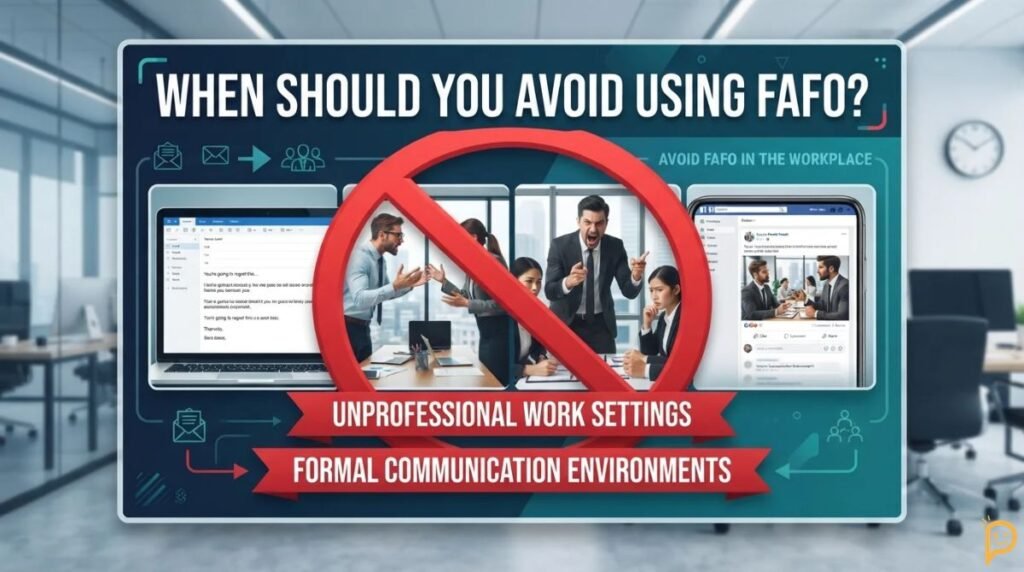
Although FAFO appears frequently online, it isn’t suitable for every situation. The original expression contains profanity, which can make it inappropriate in formal or sensitive conversations. Using it with a manager, customer, teacher, or unfamiliar person may create the wrong impression. Even close friends might misunderstand it when emotions are running high. The phrase can also sound intimidating if someone already feels uncomfortable or threatened. Before using FAFO, consider your audience and the message you want to communicate. A cleaner expression often works better when you need to sound respectful.
The same rule applies to serious disagreements and workplace conversations. A phrase that feels funny in a private group chat may sound disrespectful in a professional email. It can also make a disagreement worse when someone already feels angry. Instead of using slang automatically, choose words that fit the situation. If you want to warn someone, explain the possible result clearly. If you want to express frustration, describe the behavior that bothers you. Good communication doesn’t require harsh language to make a strong point.
Is FAFO Appropriate in Professional Communication?
FAFO usually isn’t appropriate for professional communication. Its vulgar meaning can make workplace conversations uncomfortable, especially when managers, clients, or coworkers are involved. Even if you intend it as a joke, someone might interpret it as disrespectful or threatening. It also doesn’t fit naturally into formal reports, business emails, or official messages. Instead, use clear expressions that communicate responsibility and possible results. For example, “Ignoring the safety guidelines could lead to serious consequences” sounds more professional than FAFO. The same message becomes easier to understand without unnecessary profanity.
Why You Should Avoid Using FAFO in Serious Situations
Serious situations require careful language. Using FAFO during a family dispute, workplace conflict, or sensitive discussion can make the other person feel attacked. It may also distract everyone from the actual issue. For example, telling someone “FAFO” after they experience a personal loss can sound cruel rather than helpful. Similarly, using the phrase during a heated argument may increase tension. Choose language that explains your concerns without insulting the other person. If a situation involves genuine threats or safety concerns, focus on protecting yourself rather than winning an argument.
Common Mistakes People Make When Using FAFO
People sometimes misunderstand FAFO because they focus only on its full form. They forget that the phrase can communicate different emotions in different situations. One common mistake is assuming that everyone finds the expression funny. Another is using it with strangers who don’t understand the speaker’s intention. Some people also treat it as encouragement to take dangerous risks. In reality, FAFO usually warns about the consequences of behavior rather than recommending reckless choices. You should also avoid using it in formal settings where profanity may damage your reputation. Understanding the audience prevents most of these misunderstandings.
When Is It Okay to Use FAFO?
FAFO is generally more suitable for informal conversations with people who understand your humor. You might use it in a private group chat, a gaming conversation, or a casual social media comment. It can also work as a reaction to a harmless mistake or a funny video. However, make sure the situation doesn’t involve a serious personal problem. A friendly relationship doesn’t give everyone permission to use harsh language. If the other person dislikes swearing, choose a cleaner alternative. The best time to use FAFO is when the meaning is clear and nobody feels threatened or disrespected.
Conclusion
FAFO stands for “F*** Around and Find Out.” It’s a popular slang expression that reminds people their actions can bring consequences. You’ll often see it in text messages, TikTok comments, Instagram Reels, gaming chats, and online discussions. Depending on the situation, it can sound funny, sarcastic, challenging, or threatening. Its meaning becomes much clearer when you consider the speaker’s intention and the surrounding conversation.
Now that you understand what does FAFO mean, you’ll recognize it more easily in everyday messages and online conversations. Remember that the phrase contains profanity, so it doesn’t fit every audience or situation. Use it casually when the context feels right, or choose a polite alternative when you need a softer tone. After all, understanding the words is one thing. Knowing when to use them is another.
FAQ’s About What Does FAFO Mean
What does FAFO mean?
FAFO stands for “F*** Around and Find Out.” It means someone will face the consequences of their risky, careless, or disrespectful actions.
What does FAFO mean in police terms?
FAFO isn’t an official police or legal abbreviation. Police officers may use it informally to warn that unlawful actions can lead to serious consequences.
How is FAFO pronounced?
FAFO is pronounced “fah-foh,” with two syllables and stress on the first.
What is FAFO on TikTok?
On TikTok, FAFO is internet slang used in videos, captions, and comments. It often describes someone facing consequences after making a foolish or risky decision.
What does FAFO mean in Trump?
When Donald Trump or his supporters use FAFO, they generally mean that people who challenge or oppose them may face consequences. It became especially visible in political discussions and social media posts.
You May Also Like: WTM Meaning in Text: What Does WTM Mean in Chat and Social Media?

I’m a content writer and wordplay enthusiast who loves creating clever, funny, and original puns. My goal is to bring readers fresh humour, witty jokes, and creative content that adds a smile to their day.
1 thought on “What Does FAFO Mean? Full Meaning in Text, Slang, and Social Media”