


The word perdition often appears in religious texts, classic literature, and serious conversations. But what does it actually mean? The perdition meaning refers to complete destruction, utter ruin, or eternal damnation. It can describe a person’s spiritual downfall or a terrible outcome caused by harmful choices. In Christianity, the word often connects with hell, judgment, and the fate of the soul after death.
However, perdition can also carry a figurative meaning when someone describes failure or complete disaster. Understanding its definition, origin, and usage helps you recognize this uncommon word. Let’s explore its meanings, history, synonyms, and examples in simple English.
What Does Perdition Mean?
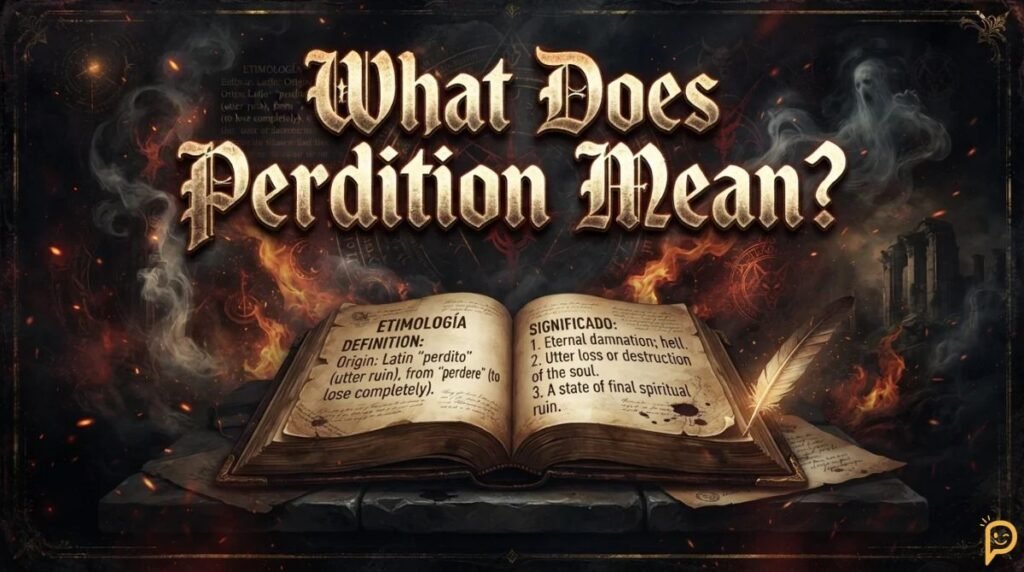
The meaning of perdition is complete destruction, utter ruin, or eternal damnation. It describes a condition in which someone experiences spiritual punishment or faces total destruction. The word often appears in religious terminology, especially when discussing Christianity, the Bible, and beliefs about the afterlife. Depending on the context, perdition can describe the fate of sinners, the spiritual downfall of wicked people, or a state of complete ruin.
In simple English, perdition means being completely lost or heading toward destruction. It can describe spiritual ruin, eternal suffering, or a terrible outcome from which recovery seems impossible. For example, someone might describe a person’s dishonest choices as a road toward perdition. This figurative use doesn’t always refer to religion. Instead, it highlights how harmful decisions can lead to serious consequences.
Perdition Meaning in Simple Words
Perdition means complete ruin or spiritual destruction. It can also describe eternal punishment in certain religious beliefs.
What Does It Mean to Be in Perdition?
Being in perdition means experiencing a state of spiritual destruction or damnation. Figuratively, it can mean living through complete failure or moving toward disaster.
Perdition Definition and Part of Speech

The standard perdition definition describes a state of eternal punishment, spiritual destruction, or complete ruin. Merriam-Webster identifies it as a noun and includes meanings connected with eternal damnation and utter destruction. In modern English, perdition is generally an uncountable literary word rather than something people use in casual conversations. Its serious tone makes it more common in religious discussions, historical writing, and dramatic storytelling.
The definition of perdition can change slightly depending on the sentence. In a religious discussion, it usually refers to damnation or the ultimate destruction of the soul. In literature, it may describe complete failure, hopelessness, or a person’s downfall. The word also carries a strong emotional tone because it suggests something far worse than an ordinary mistake. Therefore, understanding the surrounding sentence helps you identify its exact meaning.
How Do You Pronounce Perdition?
The American English pronunciation of perdition is commonly written as /pərˈdɪʃən/. It has three syllables, with the strongest emphasis on the middle syllable. The ending sounds like “shun.” When speaking, keep the middle sound clear rather than placing equal stress on every syllable.
Is Perdition a Noun or an Adjective?
Perdition is a noun, not an adjective or verb. It names a condition or state of destruction, damnation, or complete ruin. For example, in the sentence “The novel describes his journey toward perdition,” the word names the terrible condition he approaches.
What Does Perdition Mean in the Bible and Christianity?

The religious meaning of perdition focuses on spiritual destruction, condemnation, and separation from God. In Christianity, the word often describes the final fate of those who reject salvation. It connects with ideas about sin, judgment, and the afterlife. Some Christian traditions understand perdition as eternal punishment in hell, while others discuss it as final destruction or the ultimate loss of salvation. These interpretations can differ across Christian traditions and theological teachings.
The Bible uses the word perdition in several important passages. John 17:12 contains the expression “son of perdition,” traditionally associated with Judas Iscariot. Philippians 1:28 contrasts perdition with salvation, showing two very different spiritual outcomes. Second Thessalonians 2:3 also uses the expression in a passage about the man of lawlessness. These references connect perdition with final judgment, spiritual punishment, and the fate of those facing destruction. However, the exact meaning depends on the passage and its translation.
What Does Perdition Mean in the Bible?
In biblical language, perdition generally describes destruction, ruin, or a state of spiritual loss. It often stands opposite salvation and represents a tragic outcome for those who reject God’s way. For example, Philippians 1:28 contrasts the idea of perdition with salvation. The verse highlights the difference between destruction and the hope of being saved.
Does Perdition Mean Hell?
Perdition can refer to hell or eternal damnation in traditional Christian language. However, the two words don’t always mean exactly the same thing. Hell usually refers to a place or state associated with punishment after death. Perdition emphasizes the condition of destruction, damnation, or spiritual loss. Some religious writers also connect it with hellfire, Satan, and eternal suffering, although these ideas depend on particular beliefs and interpretations.
What Is the Son of Perdition?
The expression “son of perdition” appears in John 17:12 in the King James Version. It traditionally refers to Judas Iscariot, who betrayed Jesus. The expression describes someone associated with destruction or destined to perish. Second Thessalonians 2:3 also mentions a figure called the “son of perdition” in the King James Version. Some translations use “son of destruction” instead. This difference shows how translators express the same underlying idea in different ways.
Origin and History of the Word Perdition

The word history of perdition goes back several centuries. English borrowed it through Old French perdiciun, which came from Late Latin perditio. The Latin term described ruin, destruction, or loss. Its deeper root comes from Latin perdere, meaning to destroy, lose, or throw away. The word entered English through Middle English, where writers used forms such as perdicioun. Its early meanings included both physical destruction and spiritual ruin.
The etymology reveals why perdition carries such a strong meaning today. Its historical roots connect the idea of losing something completely with the idea of being destroyed. During the medieval period, religious writers increasingly used it to describe the fate of souls facing damnation. By the late fourteenth century, the word also carried a broader meaning of complete ruin and serious harm. Over time, its religious sense became especially prominent in English writing. Today, it remains a formal and dramatic word rather than a common everyday expression.
Where Does the Word Perdition Come From?
Perdition comes from the Latin word perditio, which means ruin or destruction. It passed into English through Old French before developing its Middle English form. Its Latin root perdere carries the sense of losing, ruining, or destroying something. This history explains why the modern word can describe both spiritual loss and complete destruction.
When Did Perdition First Appear in English?
Historical dictionaries generally trace perdition to the middle of the fourteenth century. Early English writers used it for spiritual damnation and the destruction of something valuable. Later, it appeared in religious works, sermons, and literary writing. Its meaning has remained closely connected with ruin and destruction ever since.
You May Also Like: Deenie Meaning: What Does Deenie Mean in Text, Slang, and as a Name?
How to Use Perdition in a Sentence (With Examples)
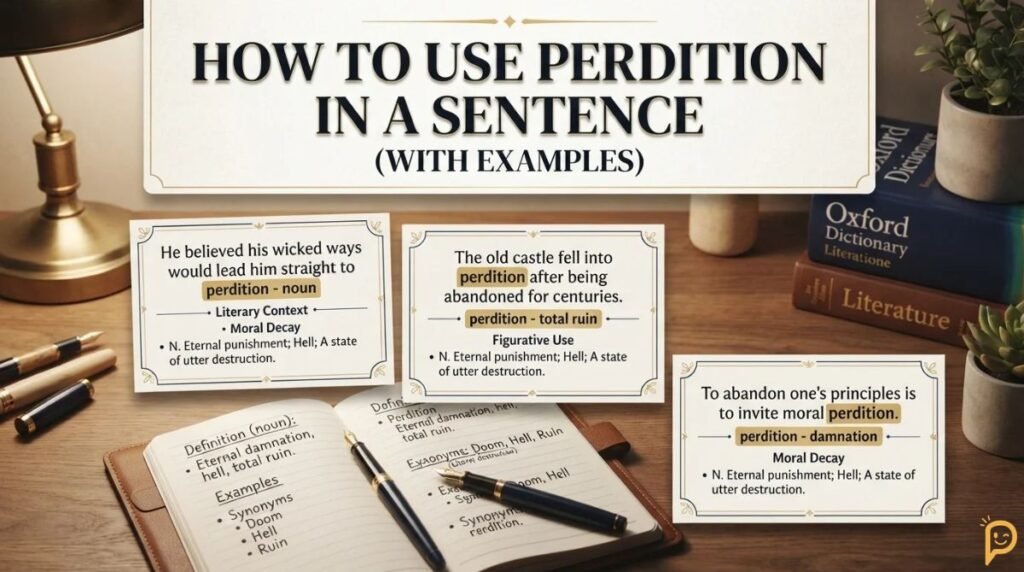
Understanding the definition becomes easier when you see perdition in real sentences. Writers often use this word to describe utter destruction, moral failure, or a person’s spiritual downfall. It usually appears in serious situations rather than casual conversations. For example, “His greed eventually led him toward perdition” describes someone whose choices brought terrible consequences. Similarly, “The kingdom faced perdition after years of corruption” uses the word to describe complete ruin. These perdition examples show how the word can work in both religious and figurative contexts.
When using perdition, pay attention to the tone and meaning of your sentence. It works best when you want to describe something more serious than ordinary failure. You can use expressions such as “fall into perdition,” “face perdition,” or “the road to perdition.” However, these expressions can sound dramatic or old-fashioned in modern American English. In everyday writing, words like destruction, downfall, or ruin may sound more natural. Perdition adds a stronger literary or religious feeling when the situation calls for it.
Examples of Perdition in Everyday English
The following sentences show how perdition can describe complete failure, serious consequences, or personal downfall.
| No. | Perdition examples | Meaning |
| 1 | His reckless decisions led him toward perdition. | His choices brought him closer to ruin. |
| 2 | The corrupt leader dragged his kingdom into perdition. | His actions caused widespread destruction. |
| 3 | Greed became the road to perdition for the businessman. | Greed eventually caused his downfall. |
| 4 | The company faced perdition after years of poor management. | The company approached complete failure. |
| 5 | She feared that dishonesty would lead her family to perdition. | She worried about the consequences of dishonest behavior. |
| 6 | Their endless arguments pushed the relationship toward perdition. | Their behavior threatened the relationship. |
| 7 | The war brought the entire region close to perdition. | The conflict caused severe destruction. |
| 8 | His obsession with power became a path to perdition. | His desire for control caused his downfall. |
| 9 | Without change, the organization seemed destined for perdition. | The organization appeared likely to collapse. |
| 10 | One terrible decision can sometimes begin a journey toward perdition. | A bad choice can lead to serious consequences. |
Examples of Perdition in Religious Contexts
These sentences demonstrate how religious writers can use perdition when discussing faith, sin, and spiritual consequences.
| No. | Example sentence | Meaning |
| 1 | The preacher warned his followers about the danger of perdition. | He warned them about spiritual destruction. |
| 2 | The passage discusses the difference between salvation and perdition. | It compares two opposite spiritual outcomes. |
| 3 | Some traditions describe perdition as eternal punishment for unrepentant sinners. | They connect it with punishment after death. |
| 4 | The sermon explored the relationship between sin and spiritual ruin. | It discussed how sin can lead to spiritual loss. |
| 5 | The story presents redemption as an alternative to final perdition. | It contrasts spiritual rescue with destruction. |
Examples of Perdition in Literature and Figurative Writing
Literary writers sometimes choose perdition because it creates a serious and dramatic atmosphere.
| No. | Example sentence | Meaning |
| 1 | The hero watched his once-great kingdom descend into perdition. | He witnessed its complete downfall. |
| 2 | Every dishonest bargain brought him closer to perdition. | His actions gradually ruined his life. |
| 3 | The novel follows a man’s slow journey toward perdition. | The story explores his gradual downfall. |
| 4 | Her ambition became the instrument of her own perdition. | Her ambition eventually destroyed her success. |
| 5 | The poet described the battlefield as a place of perdition. | The battlefield represented terrible destruction. |
Synonyms and Antonyms of Perdition

The best perdition synonyms include damnation, condemnation, destruction, ruin, and downfall. Each word shares part of perdition’s meaning, but they don’t always work in identical situations. Damnation usually carries a strong religious meaning involving punishment after death. Destruction describes something being ruined or completely damaged. Condemnation refers to a judgment that declares someone guilty or deserving of punishment. Meanwhile, ruin can describe financial collapse, personal failure, or the destruction of something valuable. Choosing the right synonym depends on what you want to express.
The perdition antonyms include salvation, redemption, deliverance, and restoration. These words describe rescue, forgiveness, or recovery instead of destruction. In religious discussions, salvation represents being saved from sin and its consequences. Redemption focuses on being rescued or restored through forgiveness or sacrifice. In everyday writing, recovery and restoration can serve as useful opposites when perdition describes complete failure. Although these words aren’t exact opposites in every context, they express ideas that move away from ruin and toward hope.
What Are the Best Synonyms for Perdition?
The following table explains common synonyms and their differences.
| Synonym | Meaning |
| Damnation | Eternal punishment or condemnation in religious belief |
| Condemnation | A judgment that someone deserves punishment |
| Destruction | The complete damaging or ending of something |
| Ruin | A state of complete failure or collapse |
| Downfall | A sudden or gradual loss of power or success |
| Ruination | The process or result of being ruined |
| Doom | A terrible or unavoidable fate |
| Inferno | A large fire or a traditional image of hell |
| Spiritual destruction | The loss or destruction of spiritual well-being |
| Eternal punishment | Punishment believed to continue after death |
What Is the Opposite of Perdition?
The opposite of perdition depends on its context. In religious writing, salvation and redemption offer the clearest contrasts. In general writing, recovery, restoration, rescue, and renewal communicate the opposite idea. These words describe moving away from destruction and toward a better condition. For example, “The community found redemption after years of hardship” expresses recovery instead of complete ruin.
You May Also Like: Deenie Meaning: What Does Deenie Mean in Text, Slang, and as a Name?
Common Phrases and Expressions Containing Perdition
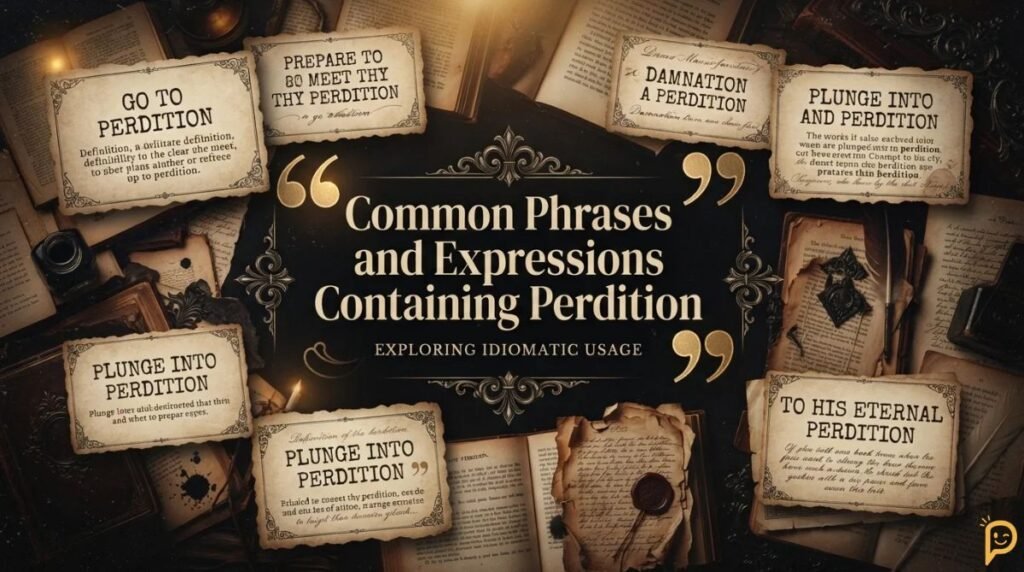
Several expressions use perdition to describe destruction, spiritual punishment, or a terrible outcome. Some phrases come from religious traditions, while others appear in literature and dramatic conversations. The expression road to perdition is especially recognizable because it describes a path toward disaster or moral decline. Other expressions, such as “fall into perdition” and “consigned to perdition,” emphasize the idea of reaching a state of complete ruin. Understanding these phrases helps you recognize the word in different types of writing.
Although these expressions sound powerful, most aren’t common in everyday American conversations. You’ll find them more often in classic literature, religious discussions, historical texts, and dramatic storytelling. Some writers also use perdition metaphorically to describe financial collapse, broken relationships, or destructive behavior. The following table explains ten useful expressions and their meanings.
| No. | Phrase | Meaning |
| 1 | Road to perdition | A path leading toward destruction or disaster |
| 2 | Fall into perdition | To enter a state of spiritual or complete ruin |
| 3 | Consigned to perdition | Sentenced or condemned to destruction |
| 4 | Final perdition | Ultimate spiritual destruction or damnation |
| 5 | Eternal perdition | A state of everlasting spiritual punishment |
| 6 | Face perdition | To face complete destruction or damnation |
| 7 | Lead someone to perdition | To guide someone toward ruin or destruction |
| 8 | Descent into perdition | A gradual movement toward complete downfall |
| 9 | Condemned to perdition | Declared deserving of spiritual destruction |
| 10 | Path of perdition | A course of behavior leading toward ruin |
Road to Perdition
The road to perdition describes a path that leads toward disaster, destruction, or moral decline. It often refers to repeated bad decisions that eventually create serious consequences. For example, “His addiction to gambling became a road to perdition” suggests that his behavior gradually ruined his life. The expression can also describe corruption, greed, dishonesty, or other destructive habits.
Go to Perdition
“Go to perdition” is an old-fashioned expression that communicates strong anger or condemnation. Someone might use it when expressing extreme frustration with another person or situation. For example, “He told the dishonest merchant to go to perdition” shows his intense anger. The expression sounds dramatic and isn’t a normal choice for polite modern conversation.
Consigned to Perdition
The phrase “consigned to perdition” means condemned to destruction or eternal punishment. It commonly appears in religious writing and older literary works. For example, “The ancient tale described the wicked king as consigned to perdition” suggests that he faced a terrible spiritual fate. The phrase emphasizes judgment and an apparently unavoidable outcome.
Is Perdition a Positive or Negative Word?
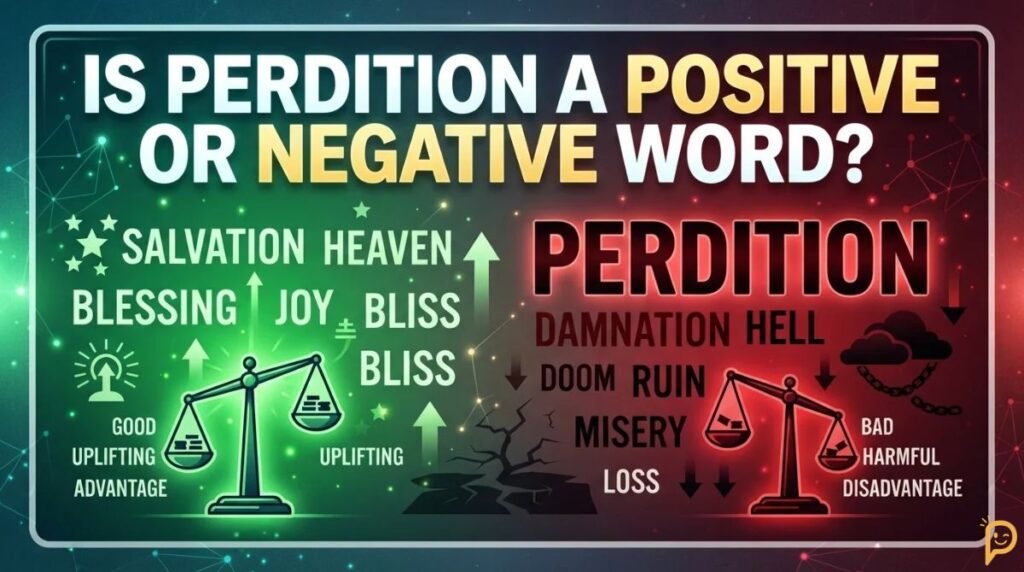
Perdition is strongly negative because it describes destruction, damnation, or complete ruin. It doesn’t normally communicate happiness, success, or hope. In religious discussions, it can describe eternal damnation, spiritual punishment, or the loss of salvation. In literary writing, it may represent a person’s downfall or the destruction of something valuable. The word also carries emotional weight because it suggests a terrible outcome rather than a temporary setback. Therefore, its meaning usually creates a dark or serious impression.
However, the exact tone depends on how someone uses it. A novelist might use perdition to create suspense or describe a character’s tragic journey. A religious speaker might use it to discuss sin, judgment, and salvation. Someone discussing a failing business could use it metaphorically to describe complete collapse. Although the word itself remains negative, writers can use it to communicate warnings, explore difficult choices, or highlight the importance of redemption.
Does Perdition Have a Bad Meaning?
Yes, perdition generally has a bad meaning because it describes destruction, ruin, or damnation. It often suggests an extremely serious condition with little hope of recovery. For example, “His greed led him toward perdition” presents greed as a destructive force. The word carries a much darker meaning than ordinary words like trouble or difficulty.
Is Perdition a Formal or Informal Word?
Perdition is a formal and somewhat old-fashioned literary word. Americans rarely use it in relaxed conversations with friends or family. However, it can appear in novels, religious discussions, speeches, and dramatic expressions. If you’re writing an academic explanation or discussing biblical theology, the word may fit naturally. For everyday situations, simpler alternatives like ruin, destruction, or downfall usually sound more natural.
Perdition vs. Damnation vs. Destruction: What’s the Difference?

Perdition, damnation, and destruction share related meanings, but each word has a slightly different focus. Perdition often describes complete spiritual ruin or eternal damnation. Damnation focuses more directly on being condemned to punishment, especially in religious beliefs. Destruction has a broader meaning and can describe physical damage, emotional harm, or the complete collapse of something. Although these words sometimes overlap, they aren’t always interchangeable. Understanding their differences helps you choose the most accurate word for your sentence.
For example, “The criminal faced damnation in the religious story” focuses on spiritual judgment. “The city faced destruction after the invasion” describes physical damage. Meanwhile, “His greed led him toward perdition” suggests a deeper state of ruin or spiritual downfall. These distinctions matter when discussing religious ideas or interpreting literature. The following comparison makes their differences easier to understand.
| Word | Main Meaning | Common Context | Example |
| Perdition | Complete ruin or spiritual damnation | Religious and literary | His choices led him toward perdition. |
| Damnation | Condemnation to eternal punishment | Religious | The story explores the fear of damnation. |
| Destruction | Complete damage or ending | Everyday, physical, and figurative | The storm caused widespread destruction. |
| Hell | A place or state associated with punishment after death | Religious and figurative | The character believed he was destined for hell. |
Perdition vs. Damnation
Perdition and damnation have closely related meanings, particularly in Christian writing. Perdition emphasizes spiritual destruction, complete ruin, or the final fate of a condemned person. Damnation focuses more directly on the act or condition of being condemned to punishment. For example, “The preacher warned about damnation” highlights judgment, while “The story describes his final perdition” emphasizes his ultimate spiritual downfall.
Perdition vs. Destruction
Destruction is a broader word that describes the complete damaging or ending of something. It can refer to buildings, relationships, businesses, communities, or natural environments. Perdition usually carries a stronger religious or literary meaning. For example, a hurricane might cause the destruction of a town, while a fictional character might face perdition because of repeated moral failures. Both words describe terrible outcomes, but their contexts differ.
Perdition vs. Hell
Hell usually refers to a place or state associated with punishment after death in various religious beliefs. Perdition can describe the condition of being spiritually lost, condemned, or completely ruined. Some dictionaries also list hell as a meaning of perdition. However, the words don’t always refer to exactly the same concept. Hell emphasizes the religious destination or state, while perdition often emphasizes destruction or damnation itself.
Final Thoughts on Perdition Meaning
Understanding the perdition meaning helps you recognize a powerful word in religious texts, literature, and everyday explanations. It generally describes complete destruction, spiritual ruin, or eternal damnation. Its historical roots connect with the idea of losing or destroying something entirely. Although the word isn’t common in casual American English, it remains useful when discussing serious consequences and spiritual beliefs.
Whether you encounter perdition in a novel, sermon, or historical passage, context helps reveal its intended meaning. Remember that it can describe both spiritual destruction and figurative downfall. Once you understand its meaning, synonyms, and common expressions, you’ll recognize this dramatic word much more easily.
FAQ’s About Perdition Meaning
What is the literal meaning of perdition?
Perdition literally means complete destruction, utter ruin, or eternal damnation. It often describes spiritual loss or a state of being condemned.
What does perdition mean in the Bible?
In the Bible, perdition refers to destruction, spiritual ruin, or damnation. It often describes the fate of those who reject salvation.
Is purgatory the same as perdition?
No. Purgatory is understood in Catholic teaching as temporary purification before heaven, while perdition refers to spiritual destruction or damnation.
What does the term road to perdition mean?
The road to perdition describes a path leading toward destruction, disaster, or moral downfall. It often involves harmful choices and their consequences.
Was The Road to Perdition a true story?
No. The Road to Perdition (2002) is a fictional crime film based on a graphic novel by Max Allan Collins, although it uses historical settings and organized crime themes.
You May Also Like: Deenie Meaning: What Does Deenie Mean in Text, Slang, and as a Name?

I’m a content writer and wordplay enthusiast who loves creating clever, funny, and original puns. My goal is to bring readers fresh humour, witty jokes, and creative content that adds a smile to their day.
1 thought on “Perdition Meaning: Definition, Origin, Synonyms, and Examples”